The Evidence Based Discovery Platform for Biomedical Research
Transforming 240M+ scientific papers into an interactive map of how genes, drugs, diseases, proteins, and pathways connect, with the evidence behind every relationship.
Scientific knowledge is growing faster than researchers can navigate it.
Millions of papers contain the evidence you need, but that evidence is fragmented across studies, disciplines and databases. Researchers spend hours searching, comparing papers, resolving contradictions and piecing together biological mechanisms.
InTree brings that evidence together in one place, so you can explore, verify and trace it.
One platform. Three ways to work with scientific evidence.
Understand what's connected.
VerifyDetermine whether the evidence supports a scientific claim.
TraceTest whether a biological mechanism holds together.
Explore the scientific landscape
See what connects to what.
Start with a gene, drug, disease, protein or research question. InTree maps the relationships surrounding it across the scientific literature. Discover established relationships, unexpected connections and emerging areas of research, all in one interactive evidence map.
Start with one question. See the whole landscape.
What is connected to metformin?
InTree maps the genes, diseases, pathways, treatments, effects and other relationships surrounding metformin, allowing you to see the broader biological landscape before diving into individual papers.
Type a gene, drug, or disease. Add more entities to see how they connect.
Find connections at the intersection of research areas
Metformin + exercise + gut microbiome
Combine multiple concepts to see where different bodies of research intersect, and uncover the relationships connecting them.
Type a gene, drug, or disease. Add more entities to see how they connect.
The map is your research workspace
Filter evidence. Focus on a relationship. Hide noise. Isolate a category. Inspect the underlying papers.
Everything you see can be investigated.
Every relationship is backed by evidence.
Click any relationship to see the exact sentences from the original publications that support it.
No black box. No hidden evidence.
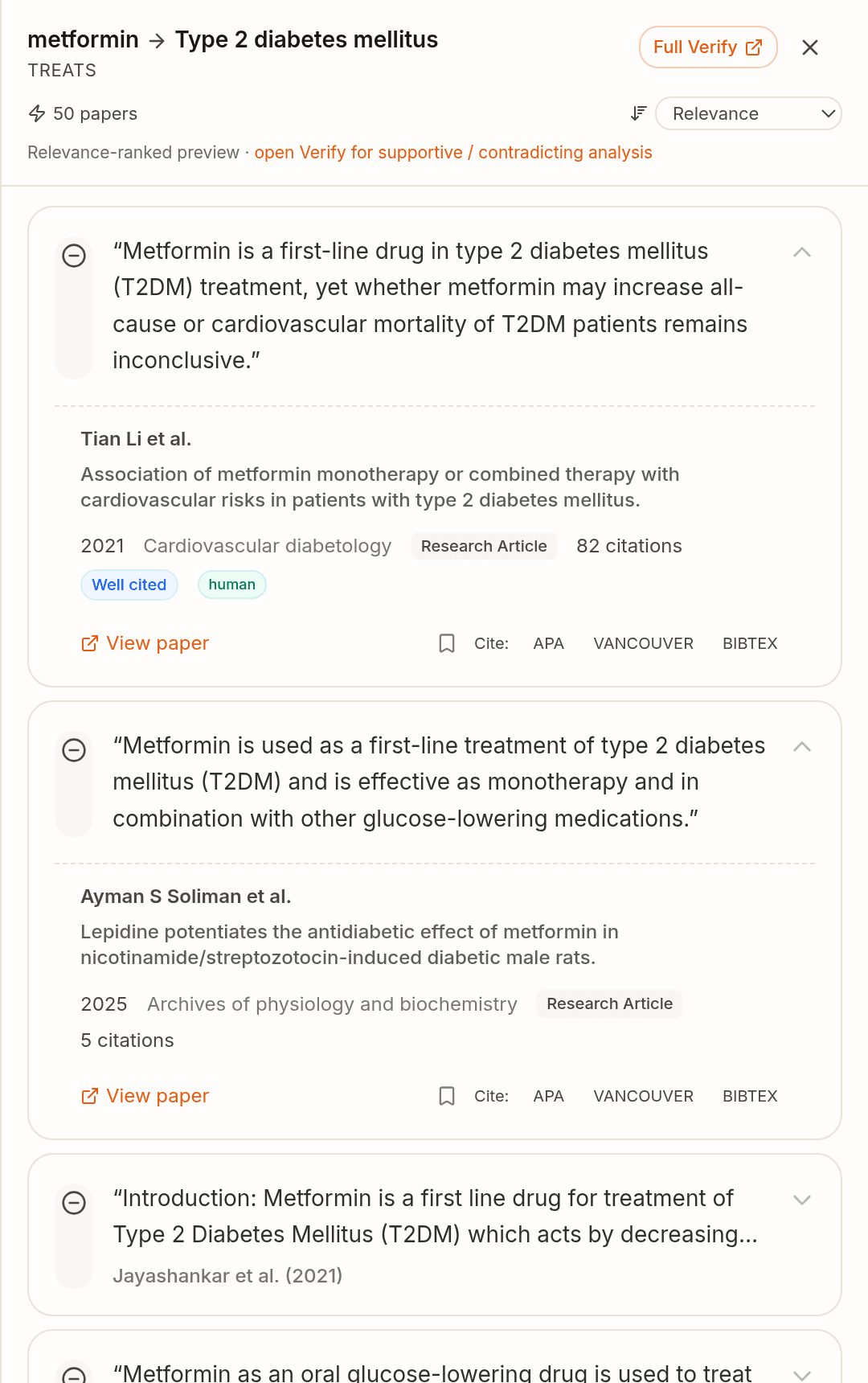
Verify scientific claims
Does the evidence actually support this relationship?
InTree evaluates the literature supporting a claim and surfaces evidence that supports, contradicts or indirectly relates to it, weighted by study quality.
See the evidence. Assess the strength. Make your own judgment.
subject ↔ related to object
Trace biological mechanisms
Does the entire pathway hold up?
Follow a proposed mechanism step by step. InTree evaluates each relationship independently, identifies the weakest link and shows where the evidence is strong, weak or missing.
A mechanism is only as strong as its weakest link.
Ask the question you’re actually working on.
Try InTree with your own research question, free, without an account.
Don’t trust the AI. Check the evidence.
Every relationship is traceable to the scientific literature.
Built on the scientific sources researchers already trust
PubMed · Semantic Scholar
Reactome · WikiPathways · Open Targets · ClinicalTrials.gov · FDA FAERS
Every quoted sentence links back to its original publication.
Start exploring scientific evidence for free.
Every example on this page runs free without an account. A free account adds your own searches every month, no card needed.
Questions, or a team or lab plan? support@intree.ai
What does the evidence say?
Put your own research question to the test. Ask about the entity you actually work on, the first searches are free.